
Community Garden Interview: Julie Hayward on ‘Try Something New’ Volunteering with Dementia Group
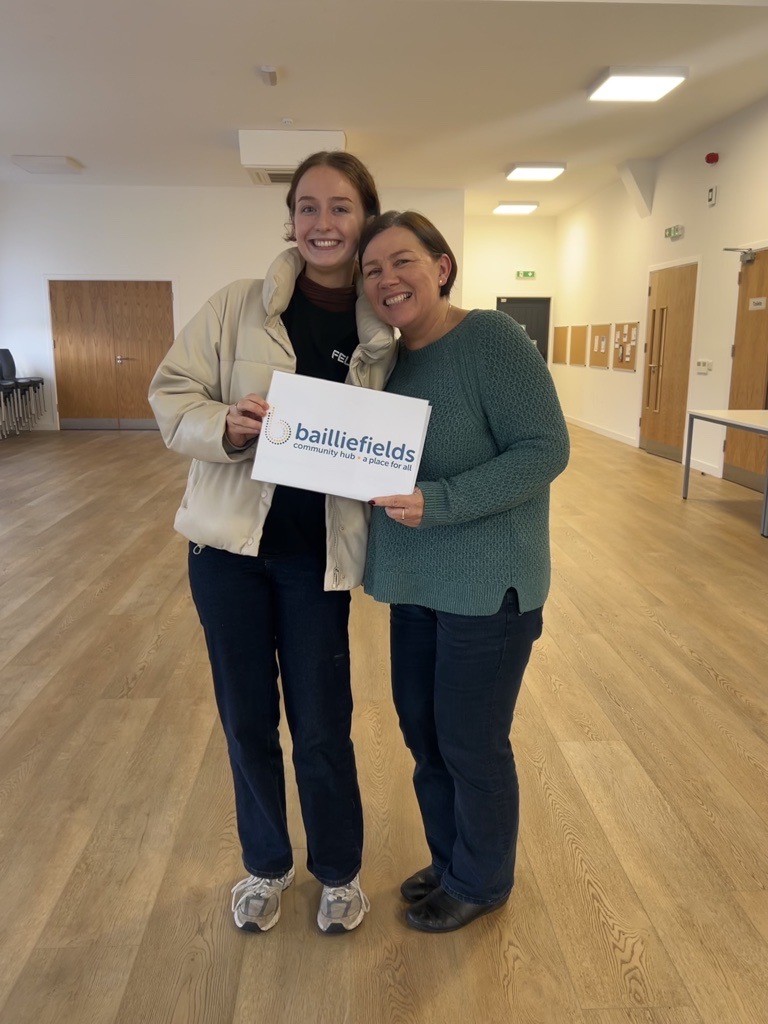
Photo: Morag and Julie, Bailliefields Community Hub
Listen to Morag, from the FEL Food & Growing team, interview Julie about her work at Bailliefields Community Hub.
Full transcript below:
Hi, thank you for joining today. We are with Julie Hayward from Bailliefields Community Hub and we are going to be discussing volunteering with dementia.
First of all, do you want to introduce yourself, Julie? What’s your name and your role in the community hub?
Hi, Morag, so I’m Julie Hayward. I am the community hub officer here at Bailliefields. Bailliefields is a volunteer organisation that’s the community wing of West Quarter and Reading Cricket Club, although my job is not anything to do with cricket and it is only to do with the community activity here.
Today, we are going to be talking about volunteering with dementia. Can you please discuss what experience and expertise you have with working and volunteering with people with dementia?
Sure, so we have a Try Something New dementia group here. It meets monthly. It’s been running since 2018. and yeah, the trustees set it up because one of their mum’s got Alzheimer’s and felt they felt that there wasn’t very much provision locally so they just set a group up. We’ve got two regular volunteers that come to it as well as myself and two of the trustees that get involved. They were approached when they were initially setting the group up back in 2018 they approached Alzheimer’s Scotland for advice on how to set the group up and they have actually partnered with us and someone from Alzheimer’s Scotland comes along to each session. It is only once a month. It’s the last Monday of every month. And Try Something New is it’s to give it a bit of a, it’s not necessarily a sporting flavour, but it’s really more about exercise and movement. Again, I think Stephen, the lead trustee felt that there was quite a lot of provision for arts and crafts kind of groups for people with dementia, but not so much going on that involved maybe sport or movement and yeah, exercise is obviously good and for physical and mental health so that’s what they that’s the road they went down so we do it’s a two hour long group and they do an hour of some kind of activity, be that indoor archery, bowls, table cricket, all sorts of different things, yoga.
And then the second hour, we just have cup of tea and a chance and a biscuit and occasionally I do a quiz or something, but really the main focus is on exercise. But yeah, it’s worked really well. And then when I started in this role, there was the opportunity to expand that group or to set something new up. So I have set up a social cafe, which is dementia friendly, but not exclusive and I just felt that there could be people in the community that were maybe living with undiagnosed dementia or maybe even were just a bit isolated and lonely and it would be good to have a group where you didn’t have to have a diagnosis of anything and it’s not an activity-based group. It really is more of a kind of lunch club. So that’s fortnightly on a Tuesday and I have a couple of volunteers that help at that too. And there’s a little bit of crossover. There are some service users who come to both, but there are some who just come to Try Something New dementia group and there are some who just come to the social cafe. So I think the two discrete groups is working quite well for us.
Amazing, thank you. Sounds like you are busy here. So what barriers have you faced when volunteering with people who have dementia at the hub and how have you overcome these barriers?
So, communication can be a bit of a barrier, depending on how advanced the person’s dementia is. We have a real mix. Some people are not so far down the road with their dementia, you wouldn’t necessarily even know. Everyone comes, it’s worth saying, everyone comes to our groups with a carer because we don’t have staff to deal with people who might need support to go to the loo or that case kind of thing. So people do come along with their carer, who is usually their husband, wife, or son, or daughter. In terms of barriers, yeah, so communication, just, I think patience and kindness really goes a long way, just giving people a bit of time, not jumping in and answering questions for them, not overwhelming people with too many questions all at once, asking them a yes, no question. Yeah, I’m just, sorry.
No, don’t worry! That’s so interesting thank you. So what misconceptions, if any, have you faced about volunteering with dementia groups?
So I suppose probably that everyone’s needs are the same. You know, people with dementia are just like the rest of the population in that they’ve got different skills and different life experiences. And so you can’t assume that because one person likes an activity, that’ll suit something else who has dementia. Some people, for example, at the Try Something New Group are still really quite active and mobile and are really up for the physical activity, whereas some people find that quite a lot more challenging we do have some that once they’re up and on their feet, you can’t get them to sit down again, which is brilliant. But we never we would never force anyone into doing anything. You know, people can take part in the activity or not, and sometimes depend on what the activity is if they’ve got a bad shoulder and we’re doing archery, then they might set that week out or whatever. But yeah, so I suppose just about treating people, it’s not a homogeneous group. They are still individuals and making sure that you take your time to find out what works for them. And to give their carers a good experience as well and really be mindful of how their dynamic works and try and just work with both the person with dementia and the person accompanying them.
Really having a few volunteers is helpful for that because you can’t spread yourself too thin. If you want to give people good attention, then you need to be quite a few members of staff or volunteers here to do that. And that does work quite well for us. We tend to have two or three volunteers at each group, which is really useful.
Amazing, thank you. What adaptions would you recommend to make it more accessible and empowering in the garden or the hub?
So I can only really speak about indoors for now because we’ve obviously started a community garden here at Bailliefields too, but it’s been more of a construction project than a garden project so far. We’ve just been building the garden this year. And we did have a think about accessibility and what might work for some of our service users with dementia when we were designing the garden, so we’ve put in quite a number of raised beds beds at all different heights that hopefully suit different groups.
So we have a nursery on site and we’re hopeful that we’ll get some children involved and we consulted with local schools when we were designing the garden. So we very much want young people to be part of the garden, but we’re hoping that our dementia groups and some of the older service users will also get involved. So we put in higher up raised beds so that there would be less bending and we’ll definitely be mindful when it comes to deciding what planting to go with about thinking about sensory planting and making sure that there’s stuff that evokes memories and that will be easy as well for people to do. So some maybe have some planting activities that it’s just a simple sort of simple garden and ts will be able to be done. Nothing that’s too tricky to look after.
But in terms of adaptations indoors in the groups, it’s just basic things really like keeping the space quite uncluttered and quiet so not having too much distracting background noise. We’ve tried different having the radio on and having music playing in the background. Our hall is really quite big and can be a bit echoey. So sometimes if there’s not very many people in it, we will have music on quietly in the background to kind of deaden the bouncy noise. But we just always kind of try and keep an eye on service users and see whether the music is bucking them or annoying people. So sometimes we have the music, oh, when I was setting up the social cafe, I did that with someone else and she did a little bit of research about having plates that were a contrasting colour to the tablecloths, because I think that was something that if it’s the same colour, it can be quite confusing with for people with dementia, that they’re not sure where the plate starts and ends. So we made sure we had brightly coloured tablecloths and then white plates and that seemed to work quite well. But so there’s just quite a lot of stuff like that to take into consideration and getting some professional advice with that sort of thing is really useful..
That’s really interesting. Thank you. So is there any training or support that you would recommend for any community groups that are struggling to include people with dementia and their activities and their volunteering?
So consulting Alzheimer’s Scotland is a really good place to start, to be honest. That’s obviously what the trustees did here when they were setting up. The Try Something New group initially, some years ago. And they’ve remained involved with our group, although when I came to set up the social cafe, they as with all sorts of volunteer organisations, they don’t have the funding now to support the social cafe, so they can’t send someone along to attend that. But that’s okay because they were happy to help with a advice. And actually, there are post-diagnosis support workers from Alzheimer’s Scotland that refer into the social cafe and the Try Something New group, and they will pop along if there’s a service user that’s having a particular problem. They’ve said to me, just to let them know if there’s someone that would benefit from them coming in. So even though they’re not supporting it regularly, they can pop in. But I think they’ve got a great website with lots of advice on it. They have a scheme called Dementia Friends Scotland, and that’s definitely worth organisations thinking about. You can do, I think it’s an hour training session. And I think if you have a number of people, they might even come out to you or you might be able to do it on teams, but it’s just a bit of advice on what it’s like to live with dementia and how you can support people so that might be really useful for other community groups that are looking at getting volunteers involved too.
And I think in terms of volunteers, peer support is probably quite good too. We tend to, I have two volunteers at the social cafe and we always have a bit of a chat at the end. It’s not official, but just a kind of debrief to chat about how we found people today and if there was anything that was worrying anyone where I would maybe then need to make a refer loan or think about other support that we should maybe look at recommending for someone that’s attending. And that doesn’t happen very often, but it’s just to be making sure that the volunteers feel that they’re being inherit too, because often they’re having conversations with the people with dementia or their carers, and I’m not necessarily party to all those conversations, so it’s useful to get their feedback and take on what’s going on.
That is important. Thank you. So what advice do you have for community groups looking to make their centres more inclusive for members of the community that have dementia?
So I suppose one thing I would say that I’ve sort of learned is that it sounds maybe a bit counterintuitive, but not necessarily advertising your groups or services as being dementia specific. Because sometimes the people who are the service users living with dementia are outsiders not so keen to identify as a member of that community, and some people are not very accepting of it or think that they don’t want to be with other people who have dementia. They have a preconception of what these groups are going to be like. So I think it’s probably worth, in terms of your advertising, thinking about not maybe having dimensions group in giant letters on the poster, rather, maybe just have that as a bit of a sub-head in so that carers, our family members can see that it is a dementia friendly group, but maybe just so we are Try Something New group, Try Something New is in big, massive letters and dementia group is in really quite small letters. So it’s not the, and also a mix of people is useful too, for everyone. And I get that that can be harder to manage maybe if people are at all different stages. But I think that it’s, yeah, that is quite a big thing that not everyone is going to say, oh, yes, I have dementia and I would like to come along to a dementia group. So just making your activities dementia friendly, rather than dementia specific is worth doing. And just kindness and patience and taking time with people as well.
So, again, we’re all facing budget cuts and, you know, money is an issue for everyone. But I think again, talking to volunteers about just being patient and just really taking time to get to know the service users of the groups and what works for them. The more volunteers you can have, probably the better, because then people can get more of a one one-to one or two to one experience and really get a bit of support while they’re with you. And yeah, and thinking about the caterers too and making sure that they are included and that their needs are being met too. For example, at the Social Cafe, we sometimes some of the gentlemen who have got dementia after we’ve had our lunch and homemade cakes that a lady brings in for us. Some of them like to play dominoes and I’ve got a volunteer or two that will sometimes do that with them, but their carers like to have a break from that, so they just sit and have a chat and get a bit of peer support and they might be chatting about their spouse and about some of the trials that they’ve had that week or they might just be having a chat about the weather or what they’ve watched on TV, but it’s just a wee bit of a break for them. It’s not complete respite because their partner is still in the room, but they’re separated in the room and they’re both having some sort of a nice experience on their own. So I think that kind of thing’s quite worth thinking about too, depending on what sort of groups people are looking to run.
Amazing. Thank you. That’s great advice. So for our final question, could you just give, what examples would you give us of how volunteering with dementia has affected someone positively?
Yeah, sure. So the social cafe, we had a couple come along. She emailed beforehand to say that they were going to join. They had been referred by their post-diagnosis support worker And it was the wife and she said that her husband really wasn’t very keen to come to a group, but the post diagnosis support worker had told him that our group was really quite new and it wasn’t too busy and not a sort of scary environment to go into, because I totally accept it can be really hard to walk through the door of a building that you’ve never been to before and if there’s lots of people there that can be really intimidating regardless of whether you have dementia or not, to be honest. But she persuaded him to come along and she emailed me after they had been the first time saying that he had absolutely loved it and had asked her when they could come back again, which was brilliant and music to my ears. So they have come every so the social cafes fortnightly and I suggested to her after they had been at a couple of social cafes that maybe they should try come to the try something new group so they actually did come along to that and have both taken part in the activities. It took the wife a bit longer to get into involved. She felt like the activities weren’t for her, but one week we just had something going on that suited her and she was really good and it was nice to see her just coming out of herself a little bit too too. But she, I think we get the best of her husband when they come to either the social cafe or they try something new group. He’s brilliant when he’s with us. And often if he didn’t speak to him for too long, you wouldn’t know that he had dementia at all, but he is actually becoming quite hard to manage at home. And she gets brilliant support from another couple who come to the Try Something New Group and the Social Cafe. And she’s actually ended up getting some respite care locally because it was recommended too hard by and the wife of another gentleman with dementia who had been going to that same respite. So she went back to her postdiagnosis support worker and asked if they could refer her at all, had to be done through social services, but she was able to access that respite support as well. And it’s actually gone up from one day to two days a week recently, which she’s really, really happy with. And I don’t know that she would have necessarily even known about that had she not met the wife of the other of the other gentlemen at the cafe.
So that kind of thing is really important too, just that sort of ad hoc peer support with where someone’s talking about something that’s worked for them, even in relation to like AID in the home. Once this gentleman is up, he’s really quite mobile and he’s gone out of their house before. And again, the other lady suggested that there were alarms that you could get to go on the door from social work. And so she’s been able to get there. and that’s been really helpful too. So I think just, yeah, you don’t, she has a family or they have a family this couple, but she really doesn’t want to burden her family. She’s her daughter wanted to give up a day a week of work and she wouldn’t let her and said, no, no, no, I I can manage. She really wants to manage herself. But she obviously does need support. And I think she is getting that in an ad-hoc capacity here at the group. Once a fortnight just sometimes doesn’t seem quite enough. So I am looking in the new year to possibly extend the group to weekly. And if I’ve got enough volunteers, I should be able to do that, I think because I think, yeah, because once a fortnight is not that much and I’m conscious that now we’re coming into Christmas, everything will be shut for two weeks, really, which is hard going for carers at home as well but we are starting our social cafe up again on the first Tuesday back after Christmas just to try and do it as quickly as possible really. So, but yeah, it’s just, you get so much out of working with these groups and it’s, yeah, personally I just really enjoy it too. It’s great feeling like you’re having a tiny impact and not every time you don’t always have a huge impact, but I think it does make a difference to people’s lives, which is fantastic. That’s why we’re all in the third sector, isn’t it?
Exactly. Well, thank you so much. That was really interesting. Thank you so much. Anything else you’d like to add or say?
No, I don’t think so. I mean, I think just I am really looking forward to the garden when we have that next year and being able to hopefully see if some of our service users would dementia would be in interested in doing some gardening and we’ll consult them too about what sorts of things they would like us to plant and, you know, build on their expertise if some of them might well have been gardeners in the past. I’m sure. some of them will have been.
Often older people that come to our groups are struggling a little bit to manage their gardens and sometimes have people in doing that for them, but even just being able to get half an hour out in our garden, hopefully when the weather permits, obviously, in Scotland. But so yeah, that’s something that I’m really excited for next year. And if I can expand the Social Cafe too to weekly, that would also be brilliant. No, it’s been, yeah, it’s really good and no, it’s been really nice to share it with you.
Amazing. Well, thank you for sharing. And I will link some of the resources that Julie spoke about in the video. Thank you.
Resources
- Please find the link to the Alzheimers Scotland Website here – https://www.alzscot.org/
- Or call the Alzheimer’s Scotland 24/7 Helpline on 08088083000
- Julie Hayward’s email for any related questions- julie.hayward@bailliefields.onmicrosoft.com


