
Community Garden Interview: The Value of Gardening on Students’ Wellbeing
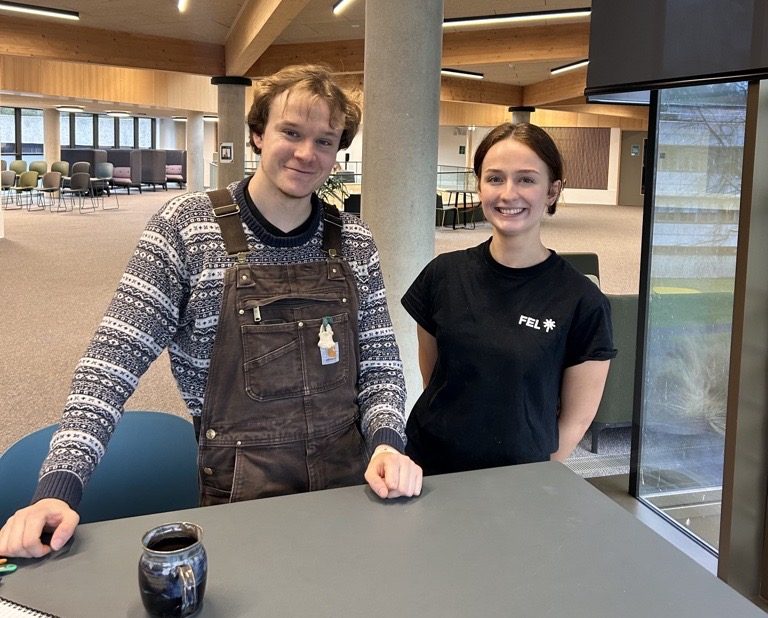
Photo: Morag from FEL Scotland and Gabi Braham from Stirling University
Listen to Morag, from the FEL Food & Growing team, interview Gabi Braham, Stirling University’s Sustainability Development Coordinator, about the university’s Green and Blue Space.
Full Transcript
Hi everyone, my name is Morag and I’m part of the Food and growing team at FEL Scotland. Today we are at Stirling University with sustainability development coordinator Gabi Braham and my colleague Sarah Donnachie from the climate team. We will be discussing the value of community gardening on students’ well-being
Can you please introduce yourself and explain your role here at Stirling University?
Hiya. I’m Gabi. Yeah, I’m the stability coordinator. and I lead on a project called the Green and Blue Space, which involves a multi project initiative and amongst one of those projects is the Community Garden, where students can get involved. and the whole project is that it’s for students to start their journey in sustainability or continue it and learn how to tackle the climate and ecological crises, crisis throughout their university experience.
Amazing. So who do you mainly work with within your role and in what ways do you interact with the community?
I work mostly and principally with students. Those are the people who I work with the most with, but also with the university management and my colleagues at the students Union. and I am quite lucky to work with external organisations, such as a Forth Environment Link, The Conservation Volunteers, and all these kind of organisations that are really helpful around the city.
From your experience, how does taking part in the community garden have a positive impact on students’ mental wellbeing and what examples have you seen of this?
I think it has a massive effect on our volunteers’ wellbeing. Yeah, or all to students that have been involved have at some point commented how just being out there in the garden has made them feel better. It’s a space to disconnect from your assignments, it’s a space to disconnect from the stress that just goes around and it’s also a really, really good space for people to gather and do an activity and then meet like-minded people whilst doing something really fun, which is gardening and learning about permaculture, learning about food growing and all these very productive things and in the meantime. So, yeah.
Amazing. Thank you. So it’s definitely affecting them positively. Have you noticed any barriers that your students have faced when taking part in community gardening and how were these overcome?
Yeah, a big one is with physical disabilities when it comes to like mobility issues. Our garden is not super, super accessible for people with mobility issues. So one of the things we did is work with the disabled association for students here at University of Stirling and they made a report for us recommending different actions that we can take in the community garden and we complete those. Those included like expanding paths to make them wheelchair accessible and also like also like walking stick accessible, having raised beds so people can like don’t have to lean to do their gardening and also getting a little mobility scooter to take anyone who might eat it from Campus Central all the way to the community garden. So there’s some things that we’ve done and to make it more accessible. I think, yeah, physical disabilities would be the big one. Yeah, I guess we also in that report, there also was a recommendation making a sensory garden to make it nice and pleasant when you go into the garden. So that’s one of the processes we’ve currently finished at the moment. We’re sewn all the bulbs for the sensory garden, so hopefully making it a bit of a more pleasant experience, like both visually, but also like smell wise, smelling nice nice flowers and it’s just making it a pleasant space.
Lovely. Do you think the community gardens are effective at bringing people together from different backgrounds or ages? And what examples have you seen of this?
Yeah, I think it’s such a nice thing to see. For us in the room space, we aim to make this new ability accessible for people who might not be doing something, for, a degree that is related to the environment. So most of our gardeners are from all different disciplines, from all different backgrounds and it’s just really, really good to see everyone getting involved. And I think it’s the well, I might be going to a future question, but I think it’s the community that people get attached to and it just happens to be gardening that is that activity that we do. So, yeah, people from nursing, from history, students, lots of environmental students, of course, but like yeah, all different backgrounds kind of join in that kind of gardening experience. And it’s, I think it’s a really good.. Amazing mix of people. Yeah. Amazing. Yeah.
In your opinion, what keeps your students and volunteers coming back to work in the garden?
Its about the community. I would say for sure is that it’s the kind of that friendly group of like it’s more people just join and see that they’s a nice friendly group. And I think that’s a really attractive prospect when you’re a student and you’re new and you’re just moved to a new city and you don’t know what to do, getting welcomed with a nice hot cup of tea, some snacks, and some gardening by lovely people, is just a nice nice thing to get be a part of. Our garden is also kind of talked about going back into the barriers. Our garden is fully funded by the Student Union. So that’s like we want to keep it like that so everyone can make use of the space and can like, can you. There’s no kind of financial barriers associated to that, so there’s no stress in in that regard. Yeah..
How do you advertise your community garden and keep track of the work being done in it?
I can definitely answer the first one. The second one is a bit a bit vague, but how we advertise it is that we have a hub, a sustainability hub on campus where all that kind of green and blue space activity happens and it’s also it’s a shop as well. So when people people come our customers come to buy kind of their ethical products, we can also like tell them about the garden. We do like in Welcome Week, which happens at the beginning of each semester, we do engaging activities, such as like seed bomb making or like fun activities for the garden and then we kind of tell a lot of students and people just show up. We also have themed weeks, two the weeks per year. One is the client festival and the other one is the Green Week where we also run engaging activities, such as like in this climate festival that just passed, we reintroduced two hedgehogs in our garden and I think hedgehogs are those species that is not only a keystone species to conserve, but also like a really cute species that people get attracted to. So like, yeah, just running fan activities and like kind of spreading the word through a hub, a physical hub on campus.
Amazing! So for the second part of that question, how do you keep track of the work done? Is it kind of everyone comes in, just does what they think needs done, or do you keep it in like a structured book or something like that?
Yeah, so there’s definitely a vision towards having a structured spreadsheet somewhere, and one of our gardeners, volunteers has done a really good progress in that. But at the moment, what we do is, because I’m fully funded, I mean, I’m a full-time staff member. I can kind of keep track of activities and I give activities on what you can do. And we keep track of that through our WhatsApp group. So everyone’s really engaged in that WhatsApp group and we all kind of talk about activities that could be done. like it kind of works at the moment, a little bit like a word of mouth kind of thing where everyone who comes to the session kind of knows what’s happening. and we’re going to introduce that to new gardens coming in and introduce them to a simple tasks and then they can take part in bigger tasks. But definitely is one of the bodies of work we need to focus on is like making it a more like structured thing for people to know kind of reoccurring events during the year. We once had like a sewing calendar that we followed that is in the shed and we kind of like referenced that sometimes. but we’re a bit, our minds are everywhere so we are normally not very good at staying still and kind of reading a document. We’re kind of really active and we want to just get get things done. So mostly the planning gets left over to the staff member and the rest of the students just enjoy the process, but like, yeah. That’s quite nice for them, though.
What lessons from the communities sorry, what lessons from the university’s community garden could be applied to community centres with a growing space?
Yeah, I think just being that central space of people meeting, I think it is it can be understated that that’s a really important thing. There’s research in this university, actually, that shows their effect on wellbeing on people. People are gardening and like how it brings people together. For us, our gardening project is the most popular. This year we have 180 of volunteers that have showed up at least once. So it’s kind of that space that people just come and congregate. And I think if a community centre had that, it’s a really hand handy thing to get people involved and and do something outdoors, which kind of gets you away from those screens and yeah. Yeah. Yeah, and then like you can also it also challenges you in a way because you’re like, okay, you keep a structure like a schedule of what you grow and then you have to think about what to do with what you grow and you can run different events with that food that you produce and kind of food always brings people together. So it’s like you to have a really valuable resource, I think.
Amazing. What tips do you have for a community growing space that are looking to get more students involved?
I think students are are very time poor, but also are very like are always focussing on the future and finding ways to kind of improve their CV and their career prospects. So like offering them valuable experience and valuable skills that they can use for future employment is a really good way to get students involved and students and attract students coming to university and just showing what you do and what your community group is always good. The Graham group it runs these two theme weekly and we’re always happy to have people come and and have a stall, to talk to our students on what you do and hopefully you can attract some of those students over to your space and we’re not protective at all of our students. I think if they get to enjoy something, that’s a win in our books. Yeah, I think kind of Korea is kind of finding ways to maybe not train them. If you can train them, great, but like if you can teach them skills and like for the future, that’s a very valuable thing that we try to do in the community garden, but you can also do in yours and yeah.
Amazing, thank you. So what impact has community gardening made on your own well being?
Well, our community garden sessions run on a Wednesday, and a Wednesday is always when there’s that dip in, like an energy and like motivation, and for me, it’s just what takes me gives me that boost for the rest of the week. I think being outdoors for me is like a big source of joy. So for me, it’s like my favourite thing. My favourite project ever and it’s like it’s super lovely to be here next to really passionate students and really lovely students. Yeah, for me, it’s just like all this combination of things just brings me joy and I think it’s the same for our volunteers. And just also seeing, for me, like connections being made through a garden project is super, super wholesome and super lovely. So for me, yeah, that boosts my serotonin levels by 100.
Amazing. Well, thank you so much for meeting here with us today. Is there any way that our listeners can get in touch with you if they have any questions?
Yeah. I’m happy to be contacted through email, which can be like attached somewhere.
Yes, I’ll attach the email to this podcast. And final question, do you have any final advice for community growers?.
I think community growing shouldn’t be anything that, which like, if you don’t know how to, have never engaged in community growing, that’s not a problem. It’s all about trial and error and just doing it. So just do it and have fun and find a community that does it and just learn on the go. If it serves with any motivation, I never had run a community garden before I came to this job and now it’s one of my favourite things to do. So like just go for it and enjoy it and meet some nice people. Thank you so much.
Thank you. We’ll just end that session here.
- Gabi’s email for any garden related questions – gabi.brame@stir.ac.uk
Resources
*If you, or someone you know is having a mental health emergency or feeling suicidal call 999.*
- Breathing Space – A confidential out of office hours telephone line for people over 16 experiencing low mood, anxiety or depression. Phone: 0800 83 85 87 Website: breathingspace.scot
- Samaritans– 24 hour helpline offering emotional support for anyone feeling down, distressed or struggling to cope.Phone: (01324) 116 123 Email: jo@samaritans.org Website: www.samaritans.org
- NHS24 – 24-hour health service for Scotland.Phone: 111 Website: www.nhs24.scot
- Stirling University Mental Health Resources Website – https://www.stir.ac.uk/student-life/support-wellbeing/student-support-services/your-mental-health-and-wellbeing/


